Deep Winter 2026 - Bundjalung Country, Northern NSW
On Saturday 12th September 2026, a group of around 50 farmers, workers, chefs, organisers, gardeners, eaters, First Peoples and food system organisations from across the Northern Rivers and beyond gathered at Murwillumbah Showgrounds, on the lands of the Bundjalung people. We came together for a democratic ‘unconference’ to share our thoughts, concerns and strategies for our local food system, to build solidarity and to strengthen the common narrative around the struggles and joys of living, growing and eating on these lands.
The day began with a beautiful smoking ceremony from Jarmbi, who welcomed us to his country. We then heard from Rob and Caitie of the AFSA National Committee, who spoke about the work AFSA is doing on First Peoples First, the Agroecology Land Trust, and the National Abattoir Campaign (see the AFSA website for more on these projects).
The diversity of the gathering was reflected in the richness of the contributions from attendees, from which emerged six major themes. These are not rigid categories, and we acknowledged the significant overlap between themes. Importantly, there was a seventh major theme that strongly underpinned all the rest, which was decolonisation and Indigenous knowledge and land management. Significant enough to be a major theme by itself, we identified that this was a topic that needed to be woven throughout any conversation on the food system, community resilience and environmental management. We were grateful to have elders of the Bundjalung Tribal Society generously share their perspective and wisdom over the course of the day.
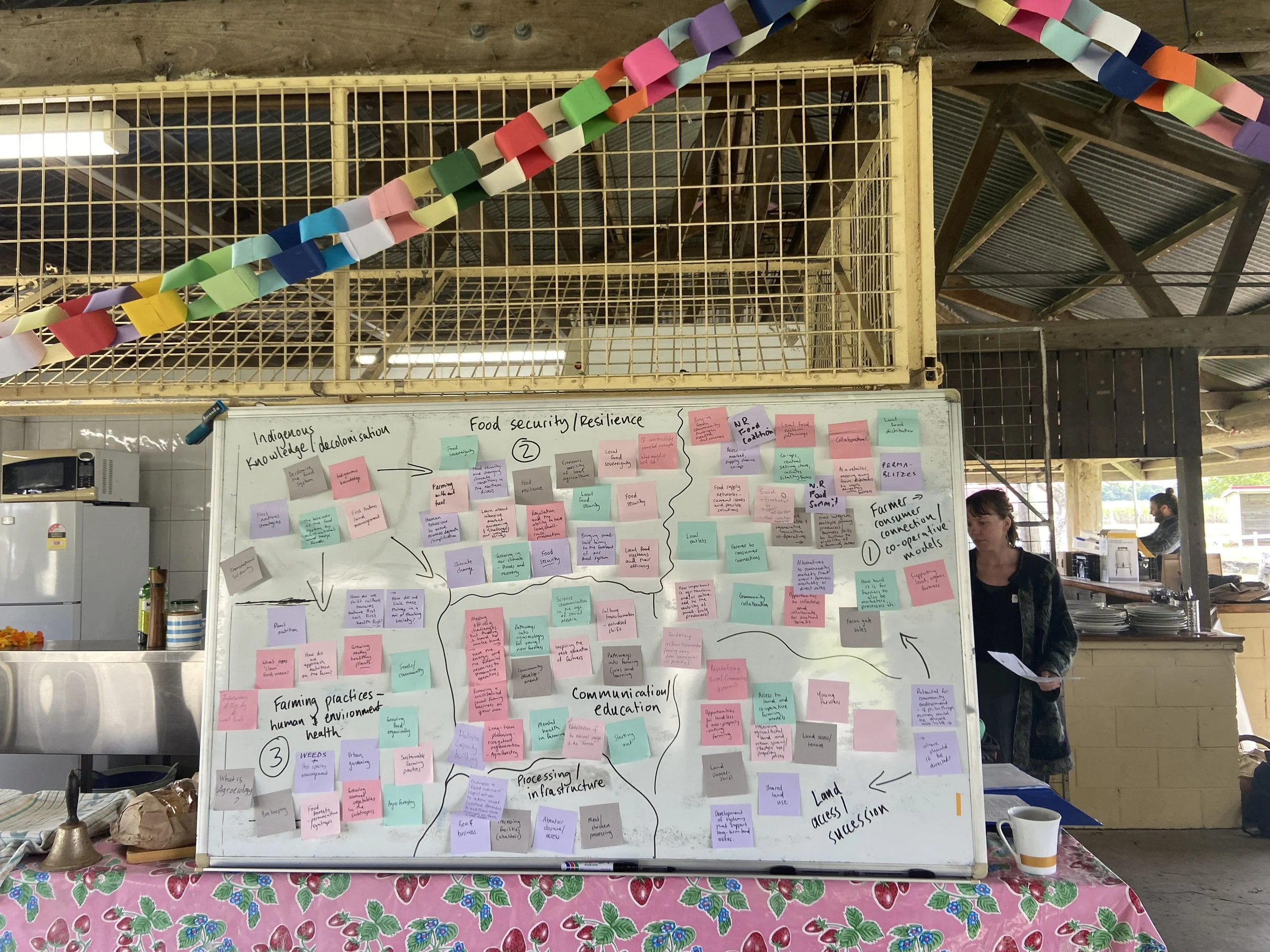
Decolonisation and Indigenous knowledge
We recognise that this land was farmed and cared for by the Bundjalung people long before colonisation, and that sovereignty was never ceded. Indigenous knowledge and land management are the foundation of any just food system, not an addition to it.
We heard how thin the current picture is: less than one percent of the native food industry is owned by Aboriginal people, even as bush foods and traditional land management move into mainstream conversation. We talked about pest species management, cultural burning, seed banks, and bush tucker knowledge not as a novelty to be added to a menu, but as the foundation our food system was built on. Important actions identified are seeking out genuine partnership (not consultation after the fact) with First Peoples' organisations on every one of the themes below, and to backing programs and funding that put Indigenous-led knowledge and enterprise at the front of the queue.
Food Security and Resilience
We are one of the most fertile regions in the country, and we are not food secure. The challenges posed by a changing climate, an ageing farming population, urbanisation of farmland and the monopolisation of food retail reveal how vulnerable our food system really is. Issues around worker’s rights – the legacy of neo-slavery, the cost of living and housing insecurity – were also discussed as a major barrier to a truly resilient food system.
We talked honestly about what resilience actually looks like: in the strength of community relationships. Resilience is diversity, accessibility, mental health, mentorship. We identified the things working for us and the opportunities they present: social enterprise farms, collective housing, and the promise of the Agrarian Land Trust.
Some things to work towards, that would build reliance in our region are building local distribution networks and a bioregional seasonal food guide, bringing Landcare groups, local council/political advocates and other organisations into the conversation and bringing consumers into this work as active participants, not passive beneficiaries. Other potential actions include: shared community stalls at the farmers markets, farm walks and tours to engage consumers, community upskilling/capacity building and cooking classes on bioregional foods.
Farmer-to-consumer connections and cooperative models
This conversation focussed on the various players within the food system and the challenges around connecting these groups. We heard about what's already working: EcoValley's CSA model, Food Connect Foundation, the Northern Rivers Food Coalition, and various existing cooperative models like North Arm Farms in Bellingen, MullumFood Coop and Granite Belt Growers association.
We also named what's getting in the way: everyone growing the same thing instead of collaborating on diversity, organic saturation without organic demand to match, scaling and start-up costs.
Improving communication and collaboration between growers would allow farmers to share the load of running and start-up costs and access new/different markets. Other important connections identified were between regional councils, distributors and marketing opportunities (Vitality Farms, local food distributors) and platforms like Uforage.
Land access and succession
Land is at the heart of the food system and yet we live in an economic system that has largely reduced it to a commodity to be traded for the accumulation of wealth, rather than the lifeforce and livelihood of the communities that live on it. We talked about the challenges that this system brings: aging farmers with no clear pathway to pass on what they've built; skilled young and new farmers with nowhere to go; the power imbalance in informal leasing arrangements; access to water and the competition between urban sprawl and farmland.
We heard about real models that can work to overcome these challenges: community land trusts, agrarian land trusts, transitional ownership and payment-plan arrangements for acquiring property, and "minimum viable training" approaches that transmit real farming and business skills to people without land. We also talked about negotiation-based approaches to land access that can connect with landowners as stakeholders by asking them what they need from land-share arrangements.
This conversation highlights the importance of succession planning in the region as important work that needs to be addressed urgently to secure local food supply.
Human/environmental health and farming practices
This conversation centered around the changing climate and the mental and practical work of accepting the shifting baseline and adapting. We talked about the importance of soil, as the foundation of both human and environmental health, and the farming practices that can rebuild soil health - diversifying crops, agroforestry, syntropic and perennial systems, integrating animals back into the system. We also talked about urban agriculture's underrated role: backyard gardens, verges and green waste turned into food grown close to the people who eat it, with none of the transport cost. Actions to work towards are sharing knowledge between farms making the transition to soil focused farming, and on-farm learning opportunities as the fastest way to spread what's working.
Communication and education
In this conversation we identified the challenges posed by the disconnect between kids and where their food comes from, the loss of knowledge around nutrient density, and the sheer distance between a farmer's paddock and a policymaker's desk.
But we also talked about what's working: grow-your-own-lunchbox programs, farmer-and-chef-to-consumer storytelling, and a hunger (from consumers as much as producers) to close the gaps between the different players in the food system. We asked how we get councils and institutions to prioritise local growers in programs that already exist, like school lunchboxes, rather than defaulting to the cheapest supplier.
Potential actions were proposed including campaigning for local-grower priority in council and school food programs and supporting knowledge exchange that runs horizontally between farmers rather than top-down.
Processing and infrastructure
The increasing lack of meat processing infrastructure in our region is a huge concern for local producers and is already the topic of a growing campaign. We talked about the real barriers: legislation built for industrial scale processing applied to small producers, raw milk still is illegal, and the cost of renting a commercial kitchen putting basic infrastructure out of reach.
We also talked about what's possible: micro-abattoirs and field harvest models, an audit of existing commercial kitchen and processing facilities to find out what's already there and underused, and native food processing capacity. With the Brisbane Olympics on the horizon, we see a real opportunity to push for localised distribution infrastructure. More work is needed to support the National Abattoir Campaign as directly relevant to our own region, and organised, coordinated lobbying for the regulatory change that small producers need.
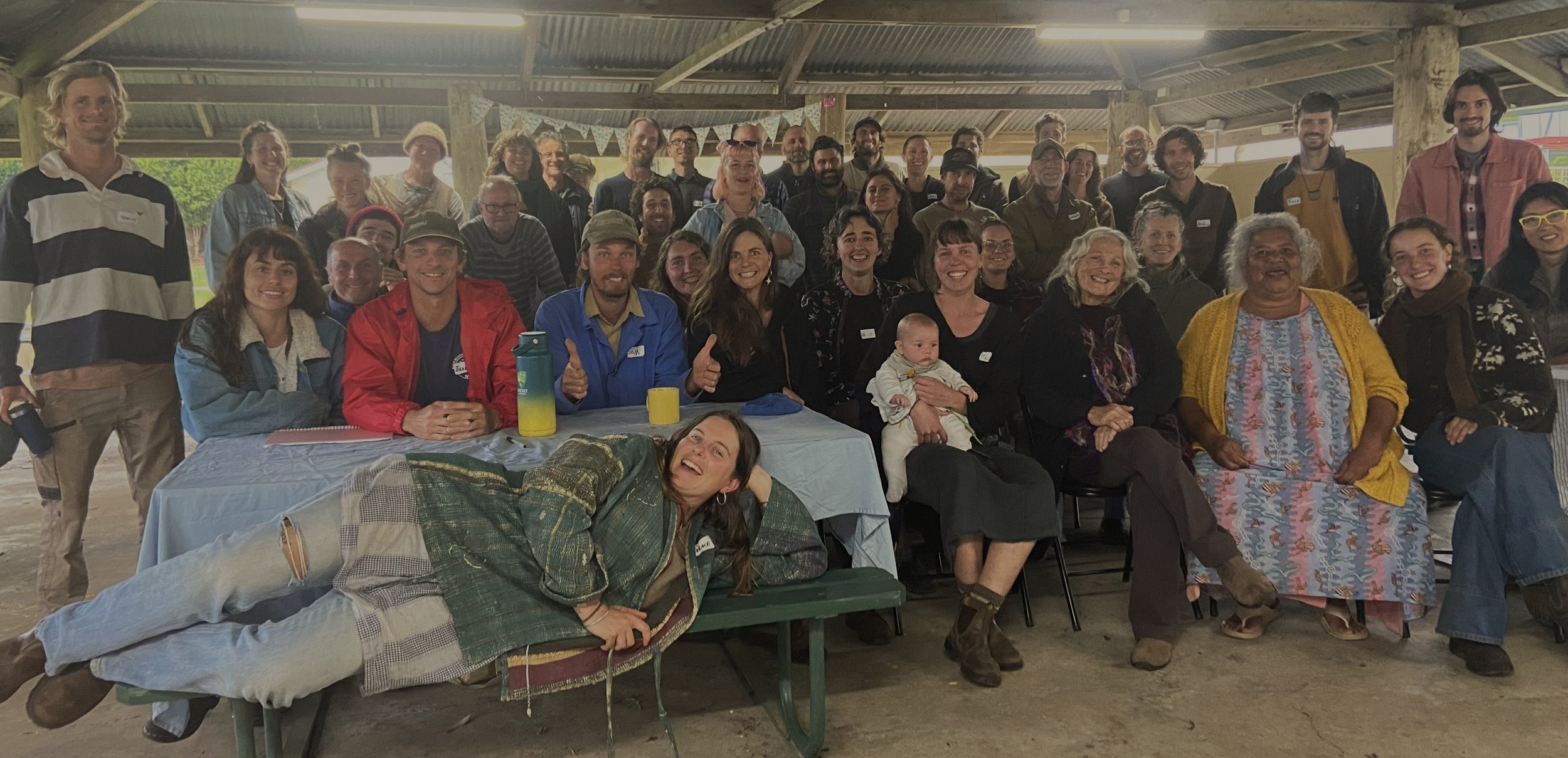
We conclude Deep Winter 2026 with a clearer map of the work ahead and a stronger sense that we're not doing it alone. Food sovereignty in the Northern Rivers isn't an abstraction, it's the daily work of farmers, cooks, organisers and Elders choosing connection over convenience. We hope that the thoughts, ideas and actions voiced at this event can become part of the larger conversation across the region and can continue to be built upon at future gatherings.